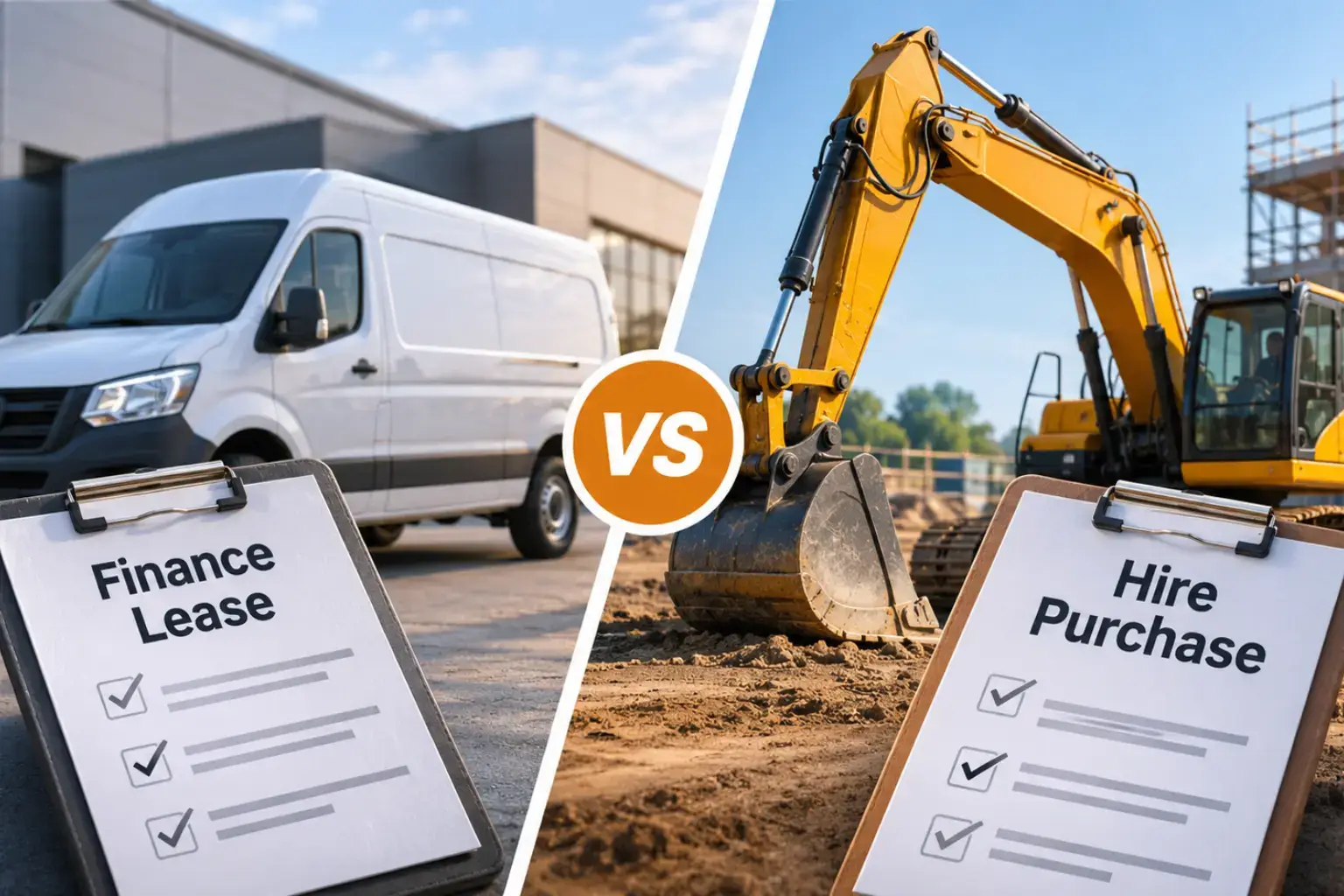
Finance Lease vs Hire Purchase: Which Is Right for Your UK Business?
Choosing how to fund a van, machine, piece of equipment or vehicle can have a major effect on your cash flow, tax position and long-term flexibility. Two of the most common asset-finance options in the UK are finance lease and hire purchase (HP). They can both help you acquire an asset without paying the full price upfront, but they work very differently when it comes to ownership, payments, and what happens at the end of the agreement.
At SimplyFunded, we help UK businesses compare funding options and find the structure that fits their plans. In this guide, we explain the differences between finance leases and hire purchases, when each option makes sense, and how they compare with a traditional business loan.
What Is a Finance Lease?
A finance lease is a long-term rental arrangement. A finance provider purchases the asset and leases it to your business for an agreed period, usually covering much of the asset’s useful economic life.
Your business pays regular rentals to use the asset, but the finance company normally remains the legal owner throughout the agreement. At the end of the primary lease term, you may be able to continue using the asset under a secondary rental period, return it, or arrange its sale and receive most of the sale proceeds, depending on the agreement.
Finance leases are commonly used for assets such as:
- Commercial vehicles and vans
- Manufacturing machinery
- Construction plant
- IT and office equipment
- Agricultural equipment
- Medical or specialist equipment
The key idea is simple: you get the use of the asset from day one, while spreading the cost across manageable payments.
What Is Hire Purchase?
Hire purchase is closer to buying an asset in instalments. Your business pays an initial deposit, followed by fixed monthly payments over an agreed term. Once all payments have been made, and any final option-to-purchase fee has been paid, ownership normally passes to your business.
With hire purchase, you are effectively acquiring the asset. You choose it, use it in your business, insure and maintain it, and expect to keep it beyond the finance term.
HP is often used for assets a business intends to retain for several years, such as:
- Delivery vans and commercial vehicles
- Machinery and production equipment
- Vehicles used as essential business tools
- Equipment with a long working life
- Assets that will retain value or support ongoing operations
The main appeal is certainty: at the end of the agreement, the asset is yours.
Finance Lease vs Hire Purchase: The Key Differences
| Feature | Finance Lease | Hire Purchase |
|---|---|---|
| Ownership during agreement | Finance company owns the asset | Finance company owns the asset until the final payment |
| Ownership at the end | Usually remains with the lender, although you may sell it as the lender’s agent | Transfers to your business after the final payment and option fee |
| Payment structure | Regular rentals | Deposit plus fixed monthly instalments |
| Best suited to | Businesses wanting flexibility or regular asset replacement | Businesses wanting to keep the asset long term |
| Asset disposal | You may sell the asset on behalf of the lender and receive most proceeds | You own the asset outright and can sell it freely |
| VAT treatment | VAT is generally charged on each rental | VAT is usually payable upfront on the asset purchase |
| Balance-sheet treatment | May be treated as a leased asset and liability | Often treated as an asset and finance liability |
| Cash-flow impact | Lower upfront commitment, with rentals spread over the term | Deposit may be required, with payments spread over the term |
The most important distinction is ownership. A finance lease gives you use of the asset, while hire purchase gives you a route to ownership.
When a Finance Lease Makes Sense
A finance lease can be a strong option if your priority is preserving working capital while still gaining access to essential equipment.
It may suit your business if you:
- Want to avoid a large upfront purchase
- Need equipment immediately but prefer to spread the cost
- Expect to replace or upgrade assets every few years
- Want flexibility at the end of the agreement
- Prefer to pay VAT through rentals rather than upfront
- Need an asset that supports revenue generation but do not necessarily need to own it
For example, imagine a logistics company that needs three additional vans to meet a new contract. Rather than using cash reserves to buy the vehicles outright, it could use a finance lease to put them on the road quickly while keeping cash available for wages, fuel, stock and marketing.
At the end of the lease, the business can review its position. If the vans are still suitable, it may continue to lease them. If newer, more efficient vehicles would reduce running costs, it can look at replacing them.
When Hire Purchase Makes Sense
Hire purchase is often the better choice when the asset is central to your business, and you expect to use it for many years.
It may suit your business if you:
- Want to own the asset at the end of the agreement
- Need equipment that will remain useful beyond the finance term
- Prefer a clear path to ownership
- Expect the asset to retain value
- Want to build an asset base for the business
- Are comfortable managing maintenance, insurance and eventual disposal
For example, a manufacturing business investing in a production machine may prefer HP. The machine may remain productive for many years, support higher output, and become part of the company’s long-term operational capacity. Once the final payment is made, the business owns it outright.
How a Business Loan Compares
A business loan is another way to fund an asset purchase. Instead of financing the asset through a lease or HP agreement, your business borrows a lump sum, buys the asset outright, and repays the loan over time.
The key difference is that a business loan is not normally tied directly to the asset. With asset finance, the asset itself often provides security for the agreement. With a business loan, the lender may look more closely at your business’s trading performance, cash flow, credit profile, and sometimes personal guarantees or other security.
| Feature | Business Loan | Finance Lease | Hire Purchase |
|---|---|---|---|
| Main purpose | General business funding or asset purchase | Use of an asset over time | Acquiring an asset over time |
| Asset ownership | Your business owns it from purchase | Finance company owns it | Your business owns it after final payment |
| Security | May require guarantees or other security | Asset is often the security | Asset is often the security |
| Flexibility of funds | Can often be used for wider business needs | Usually tied to a specific asset | Usually tied to a specific asset |
| Best for | Working capital, expansion, multiple needs | Flexible asset use | Long-term asset ownership |
A business loan can be useful when you need funding beyond a single asset. For example, you may need to buy equipment while also covering a marketing campaign, hiring staff, or managing seasonal cash-flow pressures.
However, if the main requirement is a specific vehicle or piece of equipment, asset finance such as HP or a finance lease may be more straightforward. The finance is linked to the asset; payments can be matched to the term of use, and the asset may support the agreement.
Which Option Protects Cash Flow Best?
All three options—finance lease, hire purchase and a business loan—can help protect cash flow compared with paying cash up front.
The right choice depends on what you are funding and what you want to happen later.
- Choose a finance lease if flexibility and lower upfront commitment matter most.
- Choose a hire purchase if ownership at the end is important.
- Choose a business loan if you need broader funding or want to purchase an asset outright while retaining full control from day one.
For many UK SMEs, the decision is not simply “loan versus asset finance.” It is about matching the funding structure to the asset, the length of time it will be needed, and the business’s cash-flow position.
Tax and Accounting Considerations
Tax treatment can differ between finance leases and hire purchase, so it is important to speak with your accountant before signing an agreement.
With hire purchase, the asset is often treated as belonging to the business for accounting purposes, and capital allowances may be available depending on the asset and your circumstances. VAT is commonly paid upfront on the purchase, although VAT-registered businesses may be able to reclaim it subject to normal VAT rules.
With a finance lease, rentals are generally treated as an expense, and VAT is usually charged on each rental payment rather than upfront. Because the finance company retains ownership, the asset may be treated differently in your accounts.
This is not tax advice, and the right treatment depends on your business structure, VAT status, the asset involved, and the specific agreement. A qualified accountant should review the arrangement before you commit.
Questions to Ask Before Signing
Before choosing between a finance lease and hire purchase, ask the lender or broker these questions:
- What is the total amount payable over the agreement?
- Is a deposit required, and how much?
- What is the interest rate or implied cost of finance?
- Are there arrangement fees, documentation fees, or early settlement charges?
- What happens at the end of the agreement?
- Who is responsible for maintenance, insurance, and repairs?
- Can the agreement be settled early?
- Are there mileage limits or usage restrictions?
- What happens if the asset is damaged, stolen or written off?
- Is a personal guarantee required?
These details can make a significant difference to the real cost and flexibility of the agreement.
How SimplyFunded Can Help
At SimplyFunded, we understand that every business has different priorities. Some owners want the certainty of owning an asset at the end of the agreement. Others want to preserve cash, upgrade equipment regularly, or avoid committing capital to depreciating assets.
We help UK businesses explore suitable funding options, including:
- Hire purchase agreements
- Finance leases
- Asset finance for vehicles, machinery and equipment
- Business loans for working capital, growth and asset purchases
- Refinancing options where appropriate
Our role is to help you understand the options clearly, compare the likely impact on cash flow, and identify a solution aligned with your business plans.
Whether you are buying your first commercial van, investing in new machinery or funding a major expansion, the right finance structure can help you grow without tying up all your working capital.
Frequently Asked Questions
What is the main difference between a finance lease and hire purchase?
The main difference is ownership. With a finance lease, the finance company normally owns the asset throughout the agreement. With hire purchase, your business can own the asset once all payments and any final purchase fee have been made.
Is hire purchase better than a finance lease?
Neither is automatically better. Hire purchase is usually better if you want to own the asset long term. A finance lease can be better if you want flexibility, lower upfront commitment, or the ability to review the asset at the end of the term.
Can I get a business loan instead of asset finance?
Yes. A business loan can be used to buy an asset outright, and your business would own it from the point of purchase. However, asset finance may be more suitable if the funding is specifically for a vehicle, machine or piece of equipment, because the asset can often support the agreement.
Do I need a deposit for a hire purchase?
A deposit is often required, although the amount varies depending on the lender, asset, and agreement. Some arrangements may allow a lower deposit or no deposit, but this can affect the monthly payments and total cost.
Can I end a finance lease early?
It may be possible, but early termination can involve charges. The exact terms depend on the agreement, so always check the settlement terms before signing.
Who is responsible for maintaining the asset?
In many cases, the business using the asset is responsible for insurance, maintenance, and repairs. However, this depends on the type of agreement and the terms set out by the lender.
Is VAT different for finance leases and hire purchases?
With a finance lease, VAT is generally charged on each rental. With hire purchase, VAT is commonly due upfront on the asset purchase. VAT-registered businesses may be able to reclaim VAT subject to the usual rules.
Can SimplyFunded help me compare finance lease and hire purchase?
Yes. SimplyFunded can help UK businesses assess the most suitable funding route based on the assets, budget, expected usage and long-term plans. We can also help you consider whether a business loan may be a better fit for your wider funding needs.
Looking at funding for your business?
Explore your options with SimplyFunded and find out what may suit your business.
Check your options