

Navigating small business financing requires balancing cost against speed and operational flexibility. Direct business loans—funding issued directly by a lending institution without intermediaries—have surged in popularity as alternative fintech platforms and private lenders automate underwriting. However, bypassing an intermediary means your team is responsible for assessing loan structures, hidden fees, and long-term interest costs without a broker’s advisory layer.
This guide details the operational mechanics of direct business loans, their real-world cost structures, underwriting requirements, and a framework to determine if direct lending aligns with your capital strategy.
1. Direct Lenders vs. Loan Brokers: Structural Breakdown
To select the right capitalization path, you must understand how direct lenders differ from loan brokers.
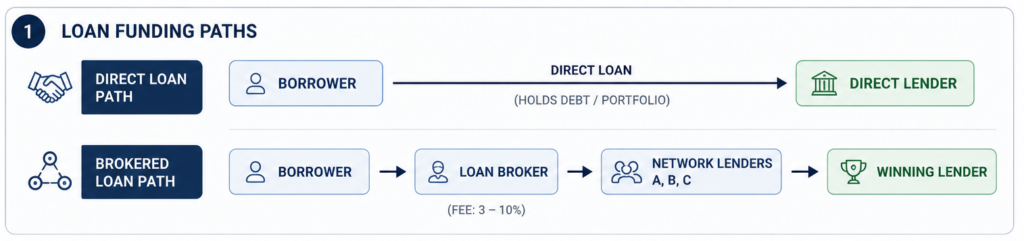
Direct Lenders
A direct lender controls its own balance sheet or institutional fund. They originate, underwrite, fund, and usually service the loan in-house.
- Execution Speed: Automated underwriting algorithms can issue approvals within 24 to 48 hours.
- Fee Transparency: You pay standard origination fees (typically 1%–5% of total loan volume) directly to the source.
- Single Product Scope: Direct lenders only sell their proprietary financial products. If their parameters do not fit your risk profile, they will reject the application rather than pivot to an alternative provider.
Loan Brokers
Brokers act as market aggregators. They collect your financial package and submit it across a network of traditional banks, non-bank lenders, and private capital funds.
- Execution Speed: Manual review and multi-lender distribution usually take 5 to 14 business days.
- Cost Structure: Brokers charge placement fees or add a percentage markup to the loan’s interest rate, increasing your effective annual percentage rate (APR).
- Broader Coverage: Useful for businesses with complex capital structures, lower credit profiles, or niche industry profiles that fail standard algorithmic underwriting filters.
| Metric | Direct Lender | Loan Broker Network |
| Approval Timeline | 24–72 hours | 5–14 business days |
| Origination & Fee Load | 1% – 5% | 3% – 10% (Origination + Broker Fee) |
| Underwriting Style | Algorithmic / Standardized | Manual / Relationship-Based |
| Best For | Clean credit, immediate capital needs | Distressed credit, complex deal terms |
2. Mathematical Underwriting Criteria: What Lenders Analyze
Direct lenders evaluate four core financial metrics to automate their risk approvals. Before submitting an application, calculate these internal figures:

1. Debt-Service Coverage Ratio (DSCR)
Lenders use DSCR to evaluate whether your business generates enough net operating income to cover new debt obligations.
DSCR = Net Operating Income (NOI) ÷ Annual Principal + Interest Obligations
- Minimum Target: Most direct lenders mandate a minimum DSCR of 1.25x. A ratio below 1.00x indicates negative cash flow relative to debt obligations.
2. Credit Score Thresholds
- 720+ FICO: Unlocks prime rates, longer payment terms, and lower origination fees.
- 660–719 FICO: Standard qualifying bracket for mainstream direct fintech lenders.
- 550–659 FICO: Shifts financing from traditional term loans into subprime short-term products or factor-rate revenue advances.
3. Revenue & Operating Footprint
- Minimum Operational History: 12 to 24 consecutive months of active business operations.
- Gross Revenue Floor: $100,000 to $250,000 in annual revenue documented via consecutive bank statements or official tax returns.
- Cash-Flow Consistency: Lenders check for erratic bank balances, daily average balances, and negative-balance occurrences (NSFs).
3. Strategic Decision Framework: Are You Ready for a Direct Loan?
Use this decision logic matrix to select the appropriate path:
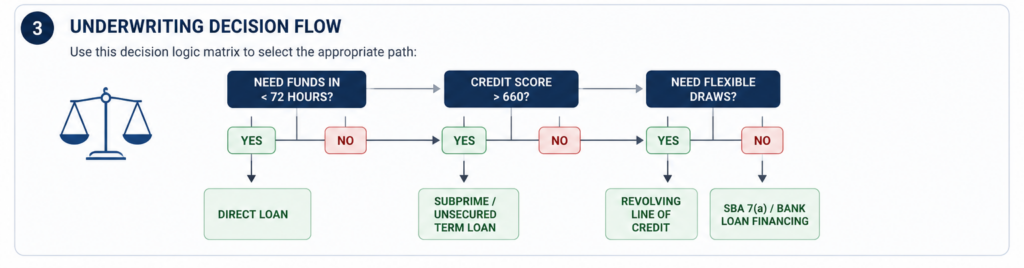
Final Assessment Check
Direct business loans make sound financial sense when:
- The Return on Capital Exceeds the Cost of Capital: The financed project generates a profit margin higher than the effective loan APR.
- Execution Velocity is Critical: Securing a inventory discount or capturing a time-sensitive market opportunity justifies paying a higher direct-lender rate.
- Cash Flow is Predictable: Fixed debt obligations will not strain operating margins during low-revenue cycles.
4. Step-by-Step Direct Loan Application Process
To minimize approval delays and prevent redundant credit inquiries, follow this direct application sequence:
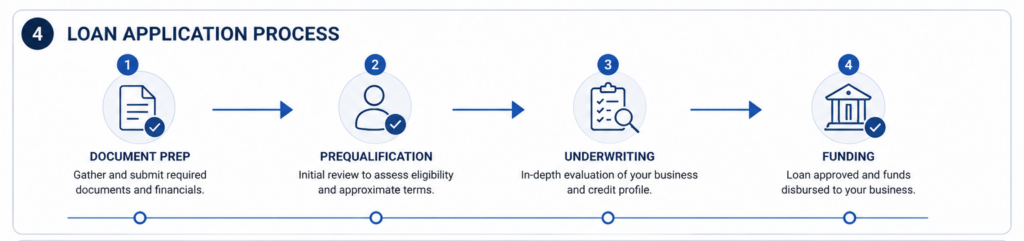
Stage 1: Document Assembly
Prepare a standardized digital data room containing:
- Financial Statements: Year-to-Date (YTD) Balance Sheet and Income Statement (P&L) certified by an accountant.
- Bank Statements: 6 to 12 months of complete corporate bank statements (all pages).
- Tax Documents: 2 years of corporate tax returns (e.g., Form 1120S or 1065) and personal tax returns (Form 1040) for principal owners.
- Ownership Verification: Articles of Organization, Operating Agreement, and corporate business license.
Stage 2: Soft-Pull Prequalification
Submit initial financial data to 2–3 vetted direct lenders using platforms that perform a soft credit check, which does not impact your credit score. Review preliminary term sheets for:
- Stated APR vs. Factor Rate
- Payment Cadence (Daily, Weekly, Monthly)
- Prepayment Penalty Clauses
Stage 3: Formal Underwriting
Select a single lender to move forward with full underwriting. The lender will conduct a hard credit pull, verify bank statement API feeds, and issue a final closing agreement.
Stage 4: Execution & Disbursement
Review the final loan disclosure statement for hidden closing costs, document processing fees, and UCC filing fees. Once executed digitally, funds are wired directly to your corporate operating account within 24 to 48 hours.
5. Direct Loans vs. Strategic Capital Alternatives
Direct term loans are not universally suitable for every capitalization requirement. Evaluate these alternatives based on your capital usage profile:
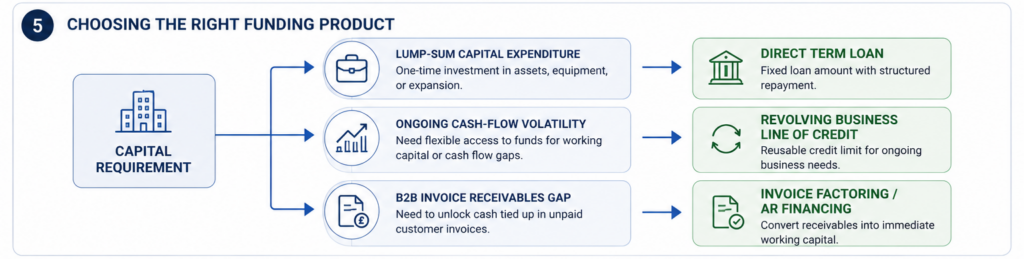
1. Revolving Business Line of Credit
- Mechanics: Access a preset credit ceiling (e.g., $100,000). Draw capital as needed and pay interest only on the drawn balance.
- Best Use Case: Managing seasonal payroll dips, unexpected short-term operating costs, or bridging cash flow gaps.
- Advantage over Direct Loans: Prevents paying interest on a lump-sum amount sitting idle in a bank account.
2. Invoice Factoring / Accounts Receivable Financing
- Mechanics: Sell outstanding B2B invoices to a funding source at a slight discount (typically 1%–4% fee) for immediate liquidity.
- Best Use Case: B2B companies with extended payment terms (Net-60 or Net-90) needing working capital to fulfill new purchase orders.
- Advantage over Direct Loans: Underwriting is based primarily on the creditworthiness of your commercial customers rather than your internal balance sheet.
3. SBA 7(a) Loans
- Mechanics: Loans issued by approved banks and partially backed by the U.S. Small Business Administration.
- Best Use Case: Long-term working capital, debt refinancing, or major acquisitions requiring prime interest rates.
- Trade-off: Approval cycles take 30 to 90 days and require extensive documentation compared to automated direct lenders.
6. Core Loan Mechanics: Secured vs. Unsecured Direct Financing
Direct business loans fall into two primary structural categories: secured and unsecured. The distinction dictates your effective cost of capital, repayment cadence, and personal liability.

A. Secured Direct Loans
Secured loans require pledging specific business or personal assets as collateral. The lender files a Blanket UCC-1 Lien or places a specific mortgage/title against the asset.
- Acceptable Collateral: Commercial real estate, yellow-iron machinery, vehicle fleets, blanket accounts receivable, or certificate of deposit (CD) reserves.
- Typical Pricing Structure:
- APR Range: Prime + 2.0% to 14.0%
- Repayment Terms: 3 to 10 years (up to 25 years for real estate)
- Risk Profile: Low risk to the lender; high asset-loss risk to the borrower if revenues contract.
B. Unsecured Direct Loans
Unsecured direct financing does not require specific physical collateral up front. However, “unsecured” is often a misnomer: almost all non-bank direct lenders require a Personal Guarantee (PG) from any owner holding 20% or more equity.
- Underwriting Basis: Approval relies strictly on historical bank cash flows, debt-service coverage, and personal credit scores.
- Typical Pricing Structure:
- APR Range: 12.0% to 35.0%+
- Repayment Terms: 6 to 36 months
- Risk Profile: High risk to the lender (compensated via higher rates); operational cash flow risk to the borrower due to aggressive payment schedules.
If your company lacks cash flow predictability or requires capital for speculative, long-term R&D, avoid high-APR direct term loans and explore equity financing or government-backed lending programs instead.